9 Smart Ways to Buy an Affordable Truck

Quick Summary
The best way to buy affordable trucks is to set a total budget first, covering price, taxes, registration, insurance and repairs, then size the truck to your actual work. Compare dealer and private sales, get a pre-purchase inspection, and negotiate the out-the-door price rather than the monthly payment.
- Set one total budget covering purchase price, sales tax, registration, insurance and a repair reserve.
- Choose truck size and configuration based on the weight you carry and tow, not imagined needs.
- Few new pickups sell under $20,000, so used trucks are where that budget becomes realistic.
- Get a pre-purchase inspection at a shop you choose, and walk away if the seller refuses.
- Get preapproved for a loan and compare total interest, not just the monthly payment.
Table of Contents
- Set Your Truck Budget Before You Shop
- Choose the Right Truck Size and Configuration for Your Work
- Compare New Trucks Under $20,000 and Lower-Priced New Models
- Where to Find Affordable Used Trucks: Dealers Versus Private Sellers
- Used Truck Inspection Checklist and Red Flags to Avoid
- Financing, Negotiating, and Timing the Cheapest Month to Buy
- Booking Your Test Drive and Next Steps at Premier AutoGroup
- Frequently Asked Questions
Set Your Truck Budget Before You Shop
Most affordable trucks purchases go wrong before the buyer ever visits a lot. The usual mistake is walking in without a number, then letting the monthly payment decide the deal. Set a total budget first, covering the purchase price, sales tax, registration, insurance and a repair reserve, and the rest of the process gets much easier.
Start with the sticker price. The price of a model like the Ford Maverick can vary widely with trim and equipment, so check current pricing from the manufacturer or dealer. A buyer who fixes a ceiling early avoids drifting toward the top of that range.
Then add what the sticker does not show. A truck that is cheap to buy but expensive to insure or repair is not a bargain. iSeeCars describes its affordable-truck analysis as weighing MSRP alongside reliability, resale value and safety ratings, which is a useful checklist for your own budget. Leave room for a iSeeCars affordable truck analysis style check on the model you pick.
Write the budget down as one number, and treat it as a ceiling, not a target.
Choose the Right Truck Size and Configuration for Your Work
Buy for the job you actually do, not the job you imagine. A contractor who hauls lumber needs a different bed and payload rating than a commuter who occasionally carries mulch. Paying for capacity you never use is one of the easiest ways to overspend.
A useful starting point is to clarify your requirements before you shop. Work through three questions: how much weight you carry, how much you tow, and how often you need four-wheel drive. Those answers usually narrow the field faster than any ranking.
Cab and bed size matter too. A crew cab seats more people but shortens the bed, while a regular cab keeps costs lower. A configuration that matches your heaviest regular load, with a little headroom, is a sensible target for most work buyers.
Compare New Trucks Under $20,000 and Lower-Priced New Models
Here is the honest answer on new trucks: very few new pickups sit under $20,000. Most affordable new trucks start in the high-$20,000s to low-$30,000s, according to CarGurus, depending on model and configuration. The U.S. News ranking lists the 2026 Chevrolet Silverado 1500 at a $36,900 base price, which is the least expensive full-size model in its result.
Check current pricing directly with the manufacturer or dealer.
For buyers who cannot stretch to a new truck, the used market is where the under-$20,000 range becomes realistic. Browse our used inventory to compare specifics against new models.
Where to Find Affordable Used Trucks: Dealers Versus Private Sellers
You have two main sources: dealerships and private sellers. Each has tradeoffs.
Dealerships typically offer financing, trade-in options, warranties and some level of inspection. You pay more than a private sale in most cases, but you gain recourse if something goes wrong. Consumer protection guidance from the Federal Trade Commission is worth reading before you sign anything (Used Cars).
Private sellers often charge less, but protections are thinner. You handle the title transfer, the inspection and the financing yourself. Scams are more common in this channel, so verify ownership and never send money before you see the truck and the paperwork.
Premier AutoGroup is a dealership serving the Magic Valley, with a no-pressure approach and a wide selection of used cars, SUVs, trucks and vans. Whichever channel you choose, the same checks apply.
Used Truck Inspection Checklist and Red Flags to Avoid
A used truck's history of work is written into its frame, drivetrain and service records. Inspect in daylight, drive on highways and rough roads, and pay an independent mechanic for a pre-purchase inspection before you commit. A pre-purchase inspection is a small cost compared with a transmission or frame repair.
Start with the paperwork. Ask for the title, the service records and the vehicle history report. A truck with no records is not automatically bad, but it shifts risk to you. Check that the VIN on the title matches the door jamb and dashboard, and that the seller's name matches the title. A common pattern is a curbstoner selling a truck he never registered; walk away if the title is not in the seller's name.
Frame and undercarriage. Rust is the most expensive problem to fix and the easiest to hide. Look for flaking scale, soft metal you can push a screwdriver into, and fresh undercoating sprayed over a patch. Pay attention to the frame rails above the rear axle and the cab mounts, where salt and moisture collect. A patched frame or a frame with visible cracks is a pass, not a negotiation point.
Drivetrain and towing wear. If the truck was used for towing, check the transmission fluid for a burnt smell and dark color, look at the hitch for heavy scoring, and ask whether an auxiliary transmission cooler was installed. On four-wheel-drive models, engage 4-High and 4-Low on a loose surface and listen for clunks. Check the differential and transfer case for seepage. A truck that towed within its ratings and had fluid changes on schedule is a better bet than one with a lift kit and oversized tires.
Body, bed and tires. Look for uneven tire wear that points to alignment or suspension problems, mismatched tires, and a bed liner that hides dents or rust. Check the tailgate for heavy loading abuse and the bed floor for cracks. Open and close every door and the tailgate; misalignment can signal a prior accident.
Red flags that should end the conversation:
- A seller who refuses an independent inspection or rushes you.
- A title that is not in the seller's name, or a "lost title" story.
- A coolant smell, milky oil, or a transmission that slips when cold.
- A frame with fresh undercoating over scale or a visible patch.
- An odometer that does not match the history report or shows rollback.
The pre-purchase inspection sequence. Book the inspection at a shop you choose, not one the seller recommends. Ask the mechanic to put the truck on a lift, scan for stored codes, check compression on high-mileage gas engines, and pressure-test the cooling system. Get the findings in writing. Use them to negotiate or to walk away. If the seller will not allow an inspection, treat that as a red flag and move on.
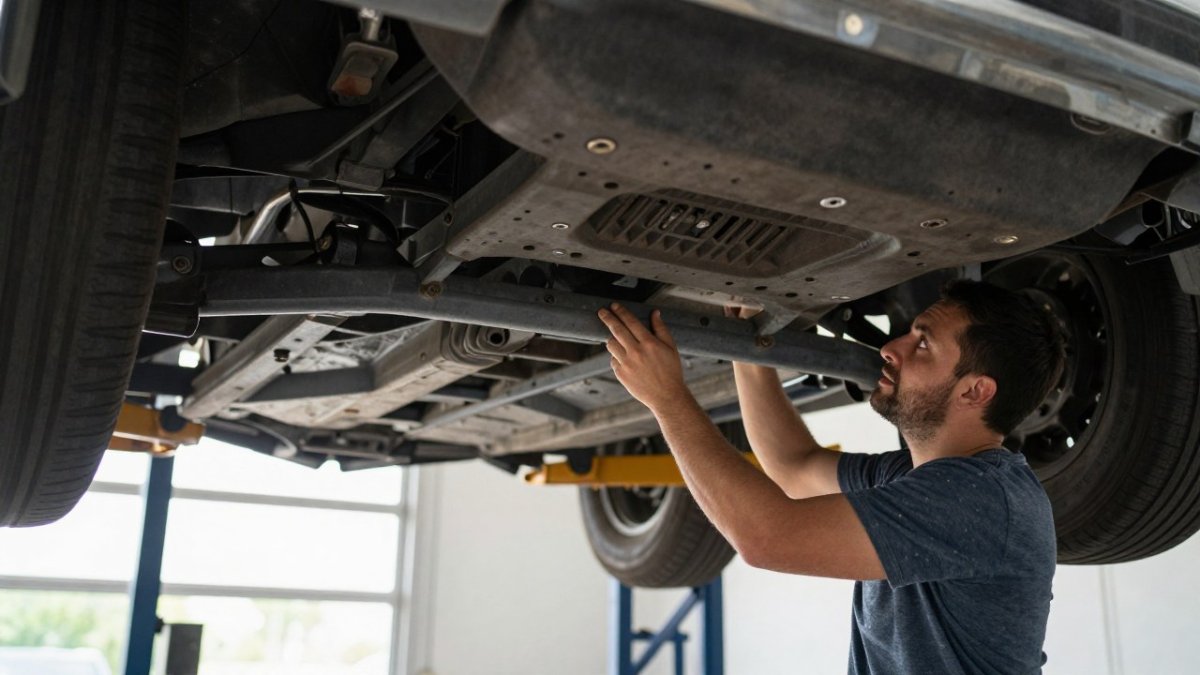 A mechanic inspecting the frame and undercarriage of affordable trucks on a lift during a pre-purchase check.
Financing, Negotiating, and Timing the Cheapest Month to Buy
Financing shapes your real cost more than most buyers expect. Compare the total amount paid over the loan, not just the monthly payment. A 72-month loan at a lower payment can cost thousands more in interest than a 60-month loan at a slightly higher payment. Ask for the annual percentage rate, the term and the total finance charge in writing before you agree.
Get preapproved first. A preapproved loan from a bank or credit union gives you a rate benchmark and turns the dealer's financing into a competing offer. Most lenders publish auto loan rates; compare at least two. A common pattern is that dealer-arranged financing carries a markup over the lender's buy rate, so ask whether the rate includes dealer reserve. If your credit is thin, a credit union or a co-signer often beats a buy-here-pay-here lot, where rates and fees run highest.
Know the out-the-door price. Negotiate on the total, not the monthly payment. The out-the-door price includes sales tax, title and registration, and dealer documentation fees. Ask for documentation fees to be itemized before you discuss price. Decline add-ons you did not request, such as paint protection, VIN etching or extended warranties, unless you have priced them separately and want them.
Negotiation tactics that work. Make an offer on the out-the-door price in writing, backed by comparable listings you have saved. Be willing to walk away; the strongest lever is a truck you do not need. If you have a trade-in, negotiate the truck price first and the trade value second, so the dealer cannot blend the two. Get the final numbers in a purchase agreement before you sign anything.
Timing the market. Many buyers find that end-of-month and end-of-year periods bring stronger incentives, because dealers push to meet sales targets. Model-year closeout is another window: when the next model year arrives, leftover new trucks often carry the deepest discounts. Used prices tend to soften in late fall and winter in many markets, while spring and summer bring more buyers. Test any pattern against current listings rather than assuming it holds every year.
Watch out: a promotion that advertises 0% APR for a short term may require top-tier credit and may exclude the trim you want; verify the terms and the total cost before you plan around it.
Federal Trade Commission auto financing guidance
The table below summarises the financing and timing points covered in this section.
| Item | Value | Note |
|---|---|---|
| Typical loan term comparison | 72 vs 60 months | 72-month loan can cost thousands more in interest |
| Figure to compare | Total amount paid | Not just the monthly payment |
| Preapproval source | Bank or credit union | Gives a rate benchmark for dealer financing |
| Price to negotiate | Out-the-door price | Includes sales tax, title, registration and fees |
| Add-ons to decline | Paint protection, VIN etching, extended warranty | Unless priced separately and wanted |
| Dealer markup to ask about | Dealer reserve | Whether the rate includes it |
| Model-year closeout | When next model year arrives | Leftover new trucks often carry deeper discounts |
| Used price softening | Late fall and winter | Test against current listings in your market |
Booking Your Test Drive and Next Steps at Premier AutoGroup
Narrow your list to two or three trucks that match your budget and job, then drive each one on roads you use every day. Bring the inspection checklist and the budget number you wrote down at the start.
At Premier AutoGroup, we give honest, no-pressure guidance. Our advisor-style team can walk you through financing options and a fair trade-in offer, and we have been voted South Central Idaho's best independent car dealership for five years in a row. Browse our trucks, book a test drive, and get approved before you commit.
Frequently Asked Questions
Where is the cheapest place to buy a truck?
Dealerships, private sellers, and online marketplaces each offer different price points, and no single source is always cheapest. Private sellers often have lower asking prices on used trucks but offer fewer protections. Dealerships charge more but typically provide inspections, warranties, and financing options. Compare the total cost of each option, including taxes, fees, and any repairs you expect in the first year, before choosing where to buy.
Is it cheaper to buy a used truck from a dealer or a private seller?
Private sellers usually ask less because there is no dealer markup, but the sale carries more risk since you have fewer legal protections and no warranty. Buying from a dealer typically costs more upfront but can include financing support, depending on the dealer. Compare the asking price, the vehicle's condition, and what you would pay to fix problems before deciding which option costs less overall.
What is the cheapest month to buy a truck?
Many shoppers find better deals at the end of the month, quarter, or calendar year, when dealers try to meet sales targets. Late in the model year, when new models are arriving, dealers often discount outgoing trucks. Timing helps, but the real savings come from comparing several trucks and negotiating from a clear budget. Ask a sales advisor about current incentives before you visit.
What should I check before buying a used truck?
Start with a vehicle history report, then inspect the frame, tires, brakes, fluids, and bed for rust or damage. Check the engine for leaks and test the transmission on a road drive. Look for signs of towing or heavy use if you plan to haul. A pre-purchase inspection by a qualified mechanic can reveal problems that are easy to miss, and it is worth paying for before you sign any paperwork.
