Where Can I Find Used AWD SUVs for Sale Near Me?

Last Updated: October 25, 2026
Quick Summary
You can find used AWD SUVs for sale near you through local listings and local dealers, which let you inspect the undercarriage and review service records in person. Filter for AWD first, then judge condition, mileage, and history in that order. Confirm the drivetrain in person, not just on the listing.
- A $20,000 budget typically buys an SUV 6 to 10 model years old with 80,000 to 130,000 miles.
- Set aside roughly 5 to 10 percent of the purchase price for immediate baselining costs.
- AWD helps you get moving on snow but does nothing for stopping; tires do that.
- Ask for differential and transfer case service records, since owners often skip them.
- Tires must be replaced in matched sets on AWD vehicles to protect the coupling.
Table of Contents
- Where to Start Your Used AWD SUV Search Near You
- Finding Reliable Used SUVs with All-Wheel Drive
- Used AWD SUVs Under $20,000: What to Expect
- AWD vs. 4WD SUVs: Which Drivetrain Fits Your Needs?
- Your Used AWD SUV Buying Checklist
- Total Ownership Costs to Budget For
- Get Approved and Find Your AWD SUV at Premier AutoGroup
- Frequently Asked Questions
Where to Start Your Used AWD SUV Search Near You
Shopping for used AWD SUVs for sale near me starts with one honest question: do you actually need all-wheel drive, or do you just want the peace of mind? In the Magic Valley, most families land firmly in the "need it" camp.
All-wheel drive (AWD) is a drivetrain system that automatically sends engine power to all four wheels when traction slips, without requiring the driver to engage anything. That automatic behavior is the key difference from traditional four-wheel drive, and it shapes how you should shop.
Why AWD Matters in South Central Idaho
Winter driving here is not a marketing problem, it's a Tuesday. AWD helps you get moving from a stop on packed snow and holds a line through slush, which is exactly the traction most local drivers actually need. What most guides miss is that AWD does nothing for stopping. Tires do that. Buy the SUV for traction, then budget for a proper set of all-weather or winter tires.
Local Listings vs. National Marketplaces
National marketplaces are useful for research, but they can't tell you whether a rig has spent five winters on salted roads. Local listings and a local dealer let you see the vehicle, check the undercarriage, and ask about service records in person. A common mistake is falling for a great national price on a vehicle that's three states away and needs a flight to inspect.
Finding Reliable Used SUVs with All-Wheel Drive
The best way to find reliable used SUVs with all-wheel drive is to filter for AWD first, then judge condition, mileage, and history, in that order. Shoppers who start with price and work backward usually end up compromising on the drivetrain they came for.
Here's what separates a good AWD listing from a risky one:
- Drivetrain confirmed in the listing, not just the trim name. "AWD" and "4WD" are not interchangeable.
- Mileage that matches the model's reputation. Some AWD systems need fluid service at specific intervals.
- Model year and trim, because AWD availability often changes between trims of the same model.
- Service records showing differential and transfer case maintenance, if applicable.
For a concrete example of what well-documented AWD inventory looks like, you can view a used Chevrolet Equinox LT AWD or check out a used Chevrolet Traverse LT AWD to see how trim, mileage, and drivetrain details are presented together.
Used AWD SUVs Under $20,000: What to Expect
A $20,000 budget buys real AWD capability, but it buys it with trade-offs.
The AWD-specific risk at this price point is deferred drivetrain maintenance. Differential fluid, transfer case fluid, and (on some models) a rear-drive coupling are the items owners skip because they are not part of a basic oil change.
At this price point, prioritize:
| Priority | Why It Matters | What to Check |
|---|---|---|
| Vehicle history | Accident history affects resale and safety | Request a full report before visiting; read the accident and title sections, not just the summary |
| AWD system health | Repairs can be costly and are easy to miss on a short drive | Ask for differential and transfer case service records; listen for whine or clunk on slow turns |
| Mileage vs. age | Low mileage on an old vehicle can mean long periods sitting | Check for dry seals, stale fluids, and tires with flat spots |
| Tires | AWD is only as good as the rubber, and mismatched tread can stress the system | Confirm matching tread depth and brand on all four; a mismatched set is a negotiating point |
| Fuel economy | Older SUVs vary widely in MPG | Compare city and highway MPG for your actual commute, not the window sticker |
| Trim and features | AWD availability often changes by trim | Confirm the drivetrain in the VIN or on the underhood label, not just the badge |
A realistic split of the budget: leave roughly 5 to 10 percent of the purchase price aside for immediate baselining, meaning fluids, filters, brake inspection, and any tire correction the seller won't cover. On a $20,000 purchase, that is a $1,000 to $2,000 cushion, and it is the difference between a good first month and a bad one.
If you want to see what's actually on the lot in your range, browse used vehicles under $20,000 and filter by drivetrain before you fall in love with a photo. When you compare two similar listings, compare the service records first and the price second; the cheaper one with documented drivetrain service is usually the better buy.
AWD vs. 4WD SUVs: Which Drivetrain Fits Your Needs?
AWD is the better fit for most families; 4WD is the better fit for people who leave pavement on purpose. That's the short answer, and it holds up in practice.
Full-time AWD keeps power going to all four wheels at all times, with a center differential or coupling that lets the wheels turn at different speeds on dry pavement. It is seamless and needs no driver input, which is why it suits commuting and winter roads. Part-time or on-demand AWD drives the primary axle in normal conditions and engages the other axle only when slip is detected. It saves fuel, but engagement can lag briefly, and the rear-drive hardware still needs fluid service even though it sits idle most of the time. 4WD typically offers a driver-selectable mode, often with a low-range transfer case, and is built for low-speed, high-traction work like towing out of mud or climbing a graded dirt road. Some 4WD systems should not be left engaged on dry pavement because the driveline binds in tight turns.
What that means for a used shopper:
- Snow and slush: AWD helps you get moving and hold a line. It does nothing for stopping or steering beyond what the tires provide, so budget for all-weather or winter tires regardless of drivetrain.
- Rain: On-demand AWD can react faster than a driver can, but hydroplaning is a tire and speed problem, not a drivetrain problem.
- Rough roads and trails: Ground clearance, tire sidewall, and approach angle matter more than the badge. A 4WD system with street tires is less capable than an AWD crossover with proper tires on a graded dirt road.
- Towing: If you tow regularly, check the vehicle's rated capacity and whether the AWD system has a towing-specific cooling or fluid interval. AWD does not automatically mean more towing capability.
Maintenance is where the systems diverge in cost.
If your week is groceries and highway miles, AWD is simpler, lighter, and usually cheaper to insure and maintain. If your weekend is a trailer and a forest service road, 4WD earns its keep. If you are honestly in between, an on-demand AWD SUV with good tires covers more real-world situations than most buyers expect.
Your Used AWD SUV Buying Checklist
Use this checklist before you sign anything. It's the same sequence we walk families through on the lot, and it catches the problems that cost the most later.
- Confirm the drivetrain in person, not just on the listing
- Pull the vehicle history report and read the accident section
- Ask for service records, especially drivetrain fluid changes
- Inspect tires for matching tread and uneven wear
- Test every electronic feature: windows, seats, cameras, screens
- Check cargo space and seating capacity against your actual family
- Take a pre-purchase inspection to an independent mechanic
- Verify the asking price against similar local listings
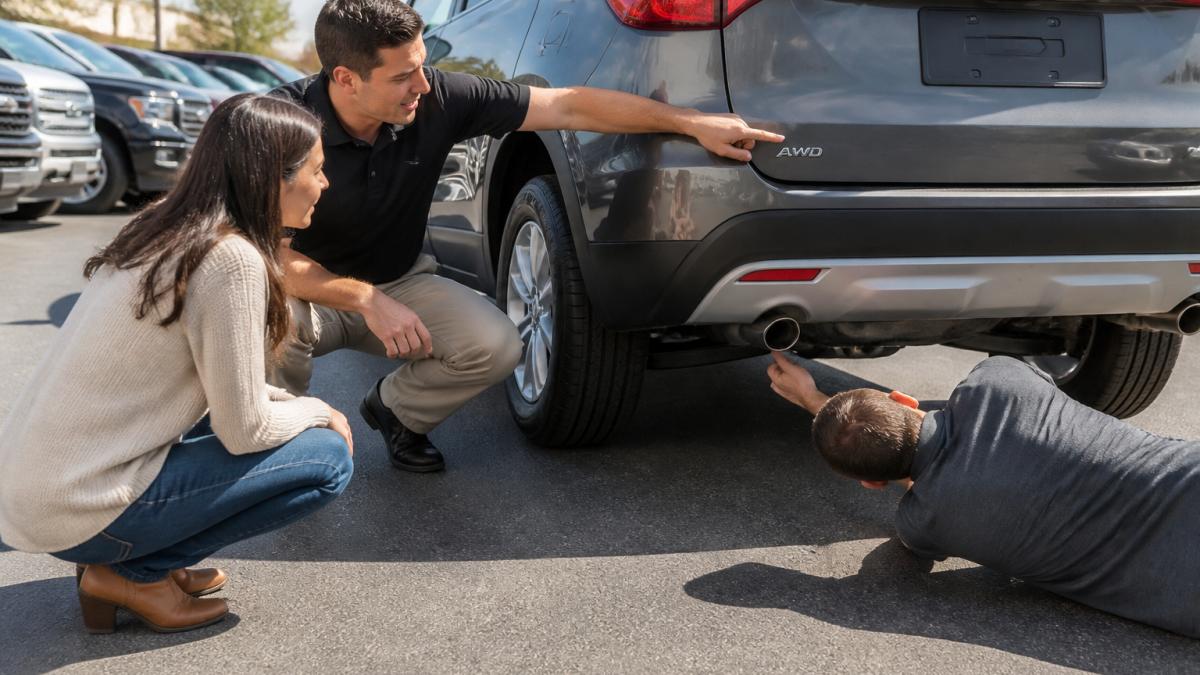 A family inspecting the undercarriage and tires of a used SUV in a dealership lot on a sunny day, with a sales advisor pointing out the AWD badge
Vehicle History and Inspection Checks
A vehicle history report is your first filter, not your final answer. It catches reported accidents, title issues, and odometer problems, but it can't see a worn differential or a leaking seal. Pair the report with a pre-purchase inspection from a mechanic who doesn't work for the seller. That combination catches nearly everything a report alone misses.
Test-Drive Tips for AWD Systems
Test the AWD on a low-traction surface if you can, and listen for whining or clunking during slow turns. A healthy AWD system should be quiet and seamless. On the highway, feel for vibration that could signal a worn component. If the seller won't allow a proper test drive, that's your answer.
Total Ownership Costs to Budget For
The purchase price is the easy part. A used AWD SUV carries ongoing costs that surprise first-time buyers, and budgeting for them now prevents a bad month later.
Beyond the loan payment, plan for fuel, insurance, tires, and maintenance. AWD vehicles often cost more to insure and to service because there are more moving parts. Tires must be replaced in matched sets to protect the drivetrain, which raises the cost per replacement. For guidance on what a fair loan looks like, the Consumer Financial Protection Bureau's auto loan guide explains how to compare offers and understand total cost.
Get Approved and Find Your AWD SUV at Premier AutoGroup
Financing is where most buyers get stuck, and it's where a local dealer can actually help. At Premier AutoGroup, we work with buyers across the credit spectrum, including folks who've been turned down elsewhere. Our advisor-style team walks you through the numbers before you commit, so there are no surprises at signing.
Here's what that looks like in practice:
- No-pressure, no-hype guidance from advisors, not traditional salespeople
- A fast, simple trade-in process with fair offers for your current vehicle
- Access to affordable, manageable car loans built around your budget
We've been voted South Central Idaho's best independent car dealership five years running, and we hold a 4.8-star Google rating. You can learn more about our buying experience before you ever walk in the door.
If you're searching from a nearby town, shop used cars for sale near Kimberly to see what's available close to home.
Frequently Asked Questions
Is AWD worth it on a used SUV?
AWD adds traction on wet, snowy, and gravel roads, which matters in South Central Idaho where winter driving is common. It can also help resale value. The trade-offs are slightly lower fuel economy and extra maintenance. If you regularly drive in poor conditions or live on a rural road, AWD is worth the cost. If you stick to cleared city streets, a two-wheel-drive SUV may save you money.
What should I check when buying a used AWD SUV?
Use a used AWD SUV buying checklist: confirm the AWD system engages, check tire tread depth is even across all four tires, review the vehicle history report for accident or flood damage, and ask for service records showing differential and transfer case maintenance. A pre-purchase inspection by an independent mechanic is the best way to catch hidden problems before you buy.
How can I tell if a used SUV has all-wheel drive?
Look for an AWD or 4WD badge on the rear hatch, check the window sticker or VIN decode, and inspect the dashboard for a drivetrain mode selector. You can also ask the seller for the original build sheet. On a test drive, AWD models often feel more planted in corners. When in doubt, a vehicle history report or dealer confirmation settles it.
Which used AWD SUVs are best for families?
Families usually prioritize seating capacity, cargo space, and safety ratings. Midsize AWD SUVs with three rows offer room for kids and gear, while compact models are easier to park and cost less to run. Look for models with strong reliability records and available driver-assist features. An advisor can help match your budget and family size to reliable used SUVs with all-wheel drive.
Ready to find an AWD SUV that fits your family and your budget? Get started with Premier AutoGroup and drive home in a vehicle you can trust, with financing that makes sense and a team that treats you fairly.
