How to Sell Your Car for Cash: A Complete Guide

Table of Contents
- Understand Your Selling Options
- How to Price a Used Car for Sale
- Prepare Your Car for Sale
- Sell My Car for Cash Online
- Private Party Car Sale Paperwork
- Safe Payment Methods for Selling a Car
- Handle Special Situations
- Compare Offers and Choose Your Selling Method
- Frequently Asked Questions
Last Updated: October 19, 2026
Understand Your Selling Options
When you sell your car for cash, you have several paths forward, each with different timelines, effort levels, and payouts.
The main routes: online instant offers (quotes in minutes), dealer trade-ins (paperwork handled), and private party sales (higher prices, more work).
Online Instant Offers
Online platforms generate an instant quote in minutes from your vehicle's details or VIN, based on market data. Offers are typically good for 7 to 14 days. You schedule an appraisal or free pickup; if you accept, the company handles title transfer and payment.
Pros of online instant offers:
- Fast process from quote to payment
- No haggling required
- Free vehicle pickup available
Cons of online instant offers:
- Initial offer may drop after in-person inspection
- Less personal interaction
- Limited negotiation room
Dealer Trade-In
Trading your current car when buying a new one simplifies the process: the dealer appraises it and credits the value toward your purchase. The dealer handles title transfer and any loan payoff, so you walk out with one vehicle instead of two.
Pros of dealer trade-in:
- One-stop shopping
- Dealer handles all paperwork
- Immediate credit toward new purchase
Cons of dealer trade-in:
- Trade-in value is often lower than private sale
- You're locked into buying from that dealer
- Less transparency on valuation
Private Party Sale
Selling directly to another person typically yields the highest price. You list your car, show it to buyers, and negotiate terms. You handle advertising, viewings, and paperwork, and the buyer may want a test drive and vehicle history report.
Pros of private party sale:
- Highest potential sale price
- Full control over negotiations
- Can sell to anyone, anytime
Cons of private party sale:
- Takes longer to find a buyer
- You handle all marketing
- More safety concerns with strangers
How to Price a Used Car for Sale
Getting the right price is critical: too high and your car sits unsold, too low and you leave money on the table. Gather your vehicle information, factor in condition and mileage, then check market data to set a competitive price.
Gather Your Vehicle Information
Your VIN (Vehicle Identification Number) is a 17-character code on your dashboard or driver's door jamb that decodes your car's exact specifications.
Write down these details:
- Year, make, and model
- Trim level and body style
- Engine type and transmission
Trim levels and options affect value significantly: a base model sedan is worth less than the same car with premium packages.
Factor in Condition and Mileage
Mileage is one of the biggest value drivers: a car with 80,000 miles is worth noticeably less than the same model with 40,000. Condition matters equally, a well-maintained car with minor cosmetic wear commands higher prices than one with mechanical issues or accident history.
Assess these condition factors:
- Paint, dents, and rust
- Interior wear and stains
- Mechanical soundness
Be honest about condition, buyers discover problems during inspection, and transparency prevents deals from falling through.
Use Market Data to Set Your Price
Check recent sales of similar vehicles in your area, comparing asking prices and actual sale prices, which often differ.
Consider these factors when comparing:
- Geographic location (prices vary by region)
- Seasonal demand (trucks sell higher in spring)
- Local market conditions
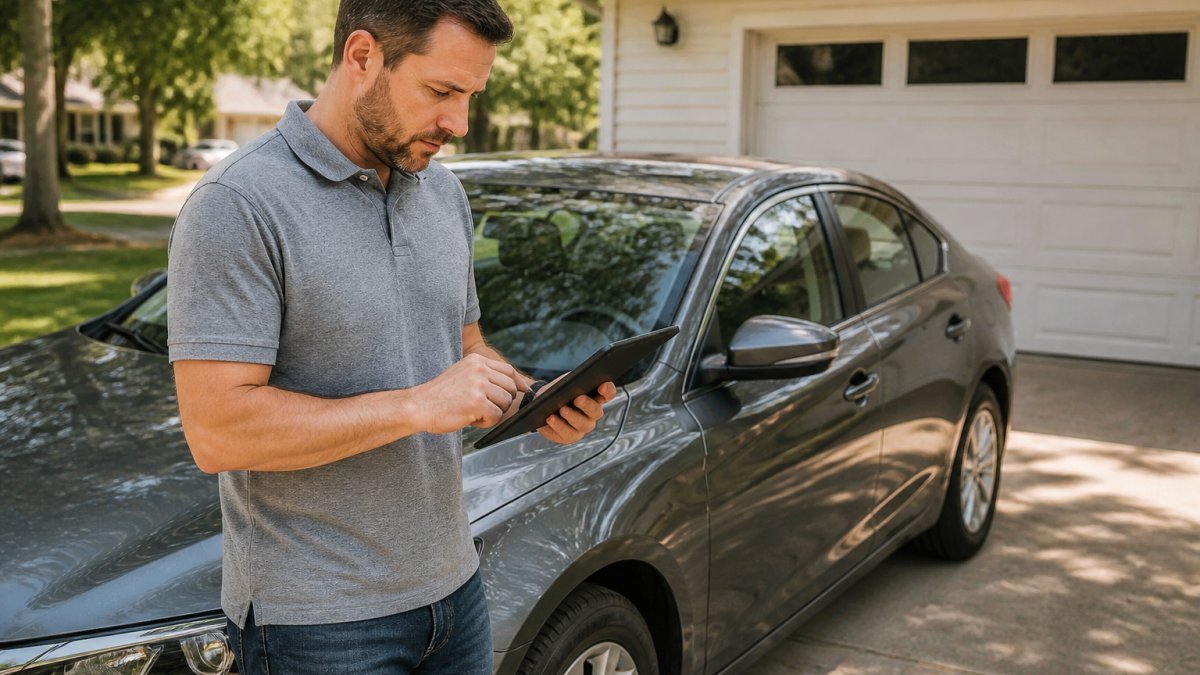 Car owner reviewing vehicle specifications and market data on tablet while standing next to their sedan in driveway
Prepare Your Car for Sale
A clean, well-maintained car attracts buyers and commands higher prices. Preparation takes a few hours but pays off in better offers and faster sales. Start with basic cleaning, address obvious mechanical issues, then gather your documentation.
Clean the Interior and Exterior
Wash your car thoroughly inside and out, a clean car looks newer and better maintained.
Exterior cleaning steps:
- Wash the body and wheels
- Clean windows and mirrors
- Polish chrome trim
Interior cleaning steps:
- Vacuum all carpets and seats
- Wipe down dashboard and steering wheel
- Clean windows and mirrors from inside
Don't overinvest in cosmetic repairs; fresh paint or new tires may not return their cost. Focus on cleanliness.
Address Mechanical Issues
Fix anything obviously broken, headlights, wipers, and warning lights should all work, and a check engine light signals problems to buyers.
Common repairs to address:
- Burned-out bulbs
- Worn wiper blades
- Leaking fluids
You don't need to replace major components unless they're failing, but address safety items and obvious wear. Buyers expect some issues; transparency prevents deals from collapsing.
Gather Your Documentation
Collect all paperwork related to your vehicle. Maintenance records, service receipts, and the owner's manual all add credibility.
Documents to gather:
- Vehicle title (clear or with lien)
- Registration documents
- Service and maintenance records
Having complete records shows you maintained the vehicle properly. Buyers feel more confident purchasing a car with documented care history.
Sell My Car for Cash Online
Online platforms make selling fast and convenient. The process typically takes one to two weeks from initial offer to payment. Here's how it works step by step.
Get an Instant Cash Offer
Start by entering your vehicle information on an online platform. You'll need your VIN, current mileage, and vehicle condition details.
Information you'll provide:
- VIN or license plate number
- Current mileage
- Exterior condition (paint, dents, rust)
The initial offer considers current market prices for your exact vehicle. Condition details adjust the offer up or down. An offer typically remains valid for 7 to 14 days.
Schedule Your Appraisal
Once you accept the initial offer, you schedule an in-person appraisal.
Be prepared for the offer to change. If the appraiser finds issues not visible in photos, the offer may decrease.
What to expect during appraisal:
- Full vehicle inspection (30 to 60 minutes)
- Test drive to check mechanical function
- Review of title and registration
Have your keys, title, and registration ready. The appraiser needs these to complete the process.
Complete the Sale
If you accept the final offer, you sign paperwork and receive payment. Most companies offer same-day or next-day payment via check or bank transfer.
Steps to complete the sale:
- Review and sign the purchase agreement
- Sign title transfer documents
- Provide proof of ownership
Payment methods vary by company. Check, bank transfer, and cashier's check are common options. Ask about payment timing before you commit.
Private Party Car Sale Paperwork
Selling privately requires more paperwork than online platforms handle. You're responsible for title transfer, bill of sale, and lien release if applicable. Each state has different requirements. Check your state's DMV website for specific forms and procedures.
Title Transfer Requirements
Your vehicle's title proves ownership. To transfer it to a buyer, you must complete your state's title transfer process.
Most states require:
- Signed title document
- Buyer's signature as new owner
- Odometer reading
Sign the title in the designated seller section. Some states have multiple signature lines for different purposes. Follow your state's specific instructions carefully.
Bill of Sale Documentation
A bill of sale is a written record of the transaction. It documents the vehicle details, sale price, buyer and seller information, and date of sale.
Your bill of sale should include:
- Vehicle year, make, model, VIN
- Odometer reading at time of sale
- Sale price in dollars
A bill of sale protects both you and the buyer. It proves the sale occurred and documents the agreed-upon price. Keep a copy for your records.
Registration and Lien Release
After the title transfers, the buyer must register the vehicle in their name. You're not responsible for this, but you should confirm it happens.
Steps to handle liens:
- Contact your lender for payoff amount
- Arrange payment from sale proceeds
- Request lien release documentation
The buyer cannot register the vehicle until the lien is released. Make sure this happens before handing over the keys.
Safe Payment Methods for Selling a Car
How you receive payment matters. Unsafe payment methods expose you to fraud and leave you without recourse if something goes wrong. Use methods that provide protection and verification.
Bank Transfers and Cashier's Checks
Bank transfers and cashier's checks are the safest payment methods for large amounts.
Bank transfer advantages:
- Direct transfer from buyer's bank account
- Funds appear in your account within 1-3 business days
- Leaves a documented trail
Cashier's check advantages:
- Guaranteed funds from the bank
- No risk of bounced checks
- Widely accepted
For bank transfers, wait for funds to clear before releasing the vehicle. Don't rely on the transfer notification alone. Contact your bank to confirm the funds have actually arrived.
Avoiding Fraud and Payment Scams
Scammers use various tactics to steal vehicles or money. Protect yourself by avoiding high-risk payment methods.
Payment methods to avoid:
- Cash (can't verify authenticity, no paper trail)
- Personal checks (can bounce days later)
- Wire transfers (often irreversible once sent)
Never release the vehicle before payment clears. "Cleared" means the funds have actually arrived in your account, not just that a deposit was made.
Handle Special Situations
Some vehicles present extra challenges when selling. Understanding how to handle these situations prevents complications and delays.
Selling a Car With a Loan or Lien
If you still owe money on your vehicle, the lender holds the title. You can't transfer clear ownership until the loan is paid off.
Steps to sell a car with a loan:
- Get payoff quote from your lender
- Ensure sale price exceeds payoff amount
- Arrange for payoff from sale proceeds
If your sale price is less than what you owe, you have negative equity. You'll need to pay the difference from your own funds to complete the sale.
Understanding Net Proceeds After Fees and Taxes
Your sale price isn't your take-home amount. Several deductions reduce what you actually receive.
Common deductions from sale price:
- Loan payoff amount
- Sales tax (varies by state and buyer type)
- Title transfer fees
Calculate your net proceeds before agreeing to a sale price. They show you the final payment amount before you accept the offer. Dealer trade-ins and private sales require more calculation on your part.
Compare Offers and Choose Your Selling Method
You've gathered information, priced your car, and prepared it for sale.
Comparison factors:
- Final offer amount
- Time to payment (same day vs. one week)
- Effort required from you
Online platforms offer speed and convenience. Dealers provide simplicity if you're buying another vehicle.
Premier AutoGroup provides competitive offers and transparent information so you can make the best choice for your situation.
Frequently Asked Questions
How do I determine what my car is worth before selling it?
Start by gathering your vehicle's VIN, mileage, year, make, model, and trim. Check real-time market data on valuation websites to see what similar vehicles are selling for in your area. Factor in your car's condition, any accidents on its history, and whether it has high-demand features. Most online platforms provide free instant offers based on this information, giving you a baseline for negotiation.
What paperwork do I need to sell my car for cash?
You'll need your vehicle title, proof of ownership, and a bill of sale. If you have a loan or lien on the vehicle, you'll need lien release documentation from your lender. For private sales, check your state's specific requirements for title transfer and registration. Keep copies of all documents for your records, and ensure the buyer receives everything needed to register the vehicle in their name.
How do I safely accept payment when selling a car?
Avoid cash payments in person when possible, use bank transfers, cashier's checks, or wire transfers instead. Meet in a safe, public location if meeting the buyer in person. Verify that payment clears before releasing the title or vehicle keys. Never sign over the title until you've confirmed the funds are in your account. Be cautious of overpayment scams or checks that bounce after you've handed over the vehicle.
Can I sell my car for cash if I still owe money on it?
Yes, but the sale proceeds must first cover your loan payoff. Contact your lender to request a payoff quote, which shows the exact amount owed. Once you receive an offer that covers this amount, the lender will release the lien after payment. You'll receive the difference between the sale price and your loan balance as net proceeds. Make sure the buyer understands the vehicle cannot be transferred until the lien is cleared.
Selling your car for cash doesn't have to be complicated or stressful. Whether you choose an instant online offer, trade-in, or private sale, understanding the process puts you in control. Premier AutoGroup's friendly, transparent team is here to answer your questions and provide top-dollar offers when you're ready to sell. Get started with a free appraisal today and see what your vehicle is worth.
