Used Truck Financing With Low Down Payment: How It Works

Last Updated: October 30, 2026
Quick Summary
Used truck financing with a low down payment usually requires about 10% to 20% down, though the average reported down payment is 14.2%. Buyers with strong credit and established business histories may qualify for less, while first-time or newer operators often pay more. Zero- and low-down offers exist but usually carry qualification conditions.
- Most lenders ask for roughly 10% to 20% down on a used truck purchase.
- The reported average down payment on a truck financing deal is 14.2%.
- First-time and newer authorities usually pay more down because lenders see them as higher risk.
- Lower credit can still qualify, but expect higher rates and possibly a larger down payment.
- Zero- and low-down offers usually come with conditions on credit, business history, and income documentation.
Table of Contents
- How Much Down Do Lenders Typically Require on a Used Truck?
- Can You Get Used Truck Financing With Bad Credit?
- Estimating Your Monthly Payment on a Used Truck
- Using Your Trade-In Value Toward a Truck Down Payment
- Low and Zero Down Offers: What the Fine Print Usually Says
- Your Next Step: Getting Pre-Approved at Premier AutoGroup
- Frequently Asked Questions
How Much Down Do Lenders Typically Require on a Used Truck?
Most lenders ask for a down payment of roughly 10% to 20% on a truck purchase, according to Crestmont Capital's 2026 trucking industry financing statistics. Buyers with strong credit and established business histories can sometimes qualify for less, while others may need more. Knowing where you fall in that range before you visit a dealership helps you plan.
The average down payment on a truck financing deal is reported at 14.2%, based on Brobas Capital's 2026 State of Truck Financing Report. That average is useful as a benchmark, but your actual number depends on your credit profile, the price of the truck, and the lender you choose.
Some sellers and finance providers advertise zero-down or low-down-payment deals. Those offers exist, but they usually come with qualification conditions, which we cover later in this guide.
Why First-Time and Newer Authorities Pay More Down
Lenders see first-time buyers and newer operators as a higher risk because they have less payment history and fewer years of documented income. For that reason, they often ask for the higher end of the range. A larger down payment reduces the lender's exposure if the loan goes bad, and it signals that you have skin in the game.
Demonstrating stable income, existing business debt that you already service well, and industry experience can help move you toward the lower end of the range over time.
Can You Get Used Truck Financing With Bad Credit?
Yes, but expect tighter terms. Lenders that work with lower credit scores generally charge higher interest rates and may require a larger down payment to offset their risk. Lower credit does not automatically disqualify you from used truck financing, but it does shape what you can borrow and at what cost.
Most commercial truck lenders sort applicants into credit tiers rather than using a single cutoff. A common pattern is three broad bands: prime (roughly 700+ FICO), near-prime (roughly 600-699), and subprime (below 600). Each tier carries its own rate range and down-payment expectation. A borrower in the prime tier is generally offered rates near the low end of the range, while a subprime borrower is more likely to face higher rates and a larger down payment. These bands are not universal, every lender sets its own, but the tier structure is how most of the market prices risk.
What Lenders Actually Look At Beyond the Score
A credit score is one input, not the whole file. Lenders also weigh:
- Time in business. Many programs require 1-2 years of active authority or documented self-employment. A newer authority is treated as higher risk even with a clean personal score.
- Payment history on existing commercial debt. A well-serviced equipment or working-capital loan can offset a thin personal file.
- Bank statements and cash flow. Lenders want to see consistent deposits that cover the proposed payment, often with a minimum monthly revenue threshold.
- Down payment and collateral. A larger down payment or a truck with strong resale value reduces the lender's exposure and can pull an approval into a better tier.
- Personal guarantee. Most commercial truck loans are personally guaranteed, so the owner's personal credit is part of the decision even when the loan is in a business name.
Practical Steps to Strengthen a Bad-Credit Application
If your score is the weak point, you can still improve your position before you apply:
- Pull your reports first. Dispute errors and pay down revolving balances to lower utilization, both can move a score within a billing cycle or two.
- Bring a co-signer or guarantor with stronger credit. This is one of the few levers that can change your tier outright.
- Increase the down payment. Moving from 10% to 20% down can shift a borderline file into approval, and it lowers the amount financed.
- Document income thoroughly. Recent bank statements, tax returns, and a profit-and-loss summary reduce perceived risk.
- Shop multiple lenders. Credit unions, commercial truck lenders, and dealer-arranged financing price the same borrower very differently.
Be cautious with advertised offers that sound too good to be true. A consumer study on auto buyers and advertised 0% financing found that some shoppers attracted to a zero-percent offer did not qualify because their credit scores were too low. Ask the dealer directly what credit tier the advertised rate requires.
Premier AutoGroup works with buyers in a range of credit situations. Our team can walk you through realistic options so you know what to expect before you commit to a truck. You can also read about our service center and how we handle repairs and updates.
Estimating Your Monthly Payment on a Used Truck
Your monthly payment depends on three main factors: the amount you finance, the interest rate, and the loan term. A higher price or longer term raises the payment, while a bigger down payment or lower rate reduces it.
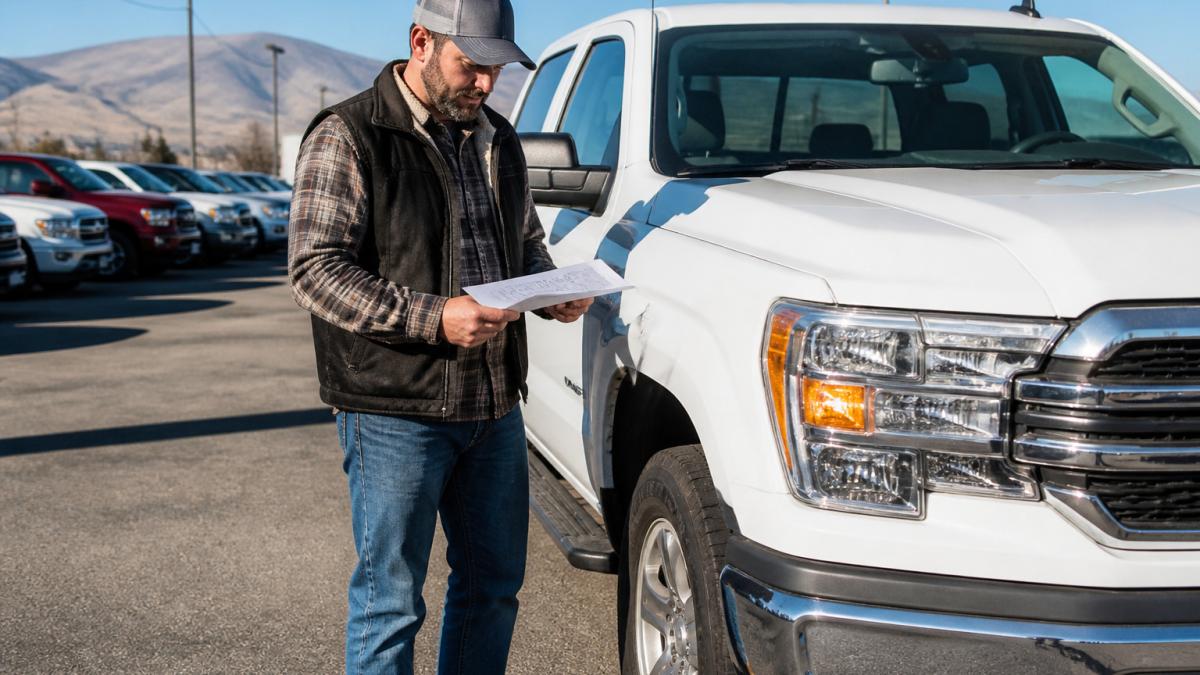 Contractor reviewing loan paperwork for used truck financing at a sunny Idaho dealership lot
Commercial truck financing rates can range from roughly 6% to 35% APR, depending on credit profile, lender type, and time in business, according to industry analysis of commercial truck financing options. That spread is wide, so the rate you are quoted matters as much as the price. Borrowers with less than perfect credit histories often face higher interest costs, yet qualifying for equipment financing remains a viable path for those who understand how to leverage their business assets to secure more favorable terms.
Worked Down-Payment Scenarios
Here is an illustrative example so you can see how the down payment, rate, and term interact. Figures are assumptions only, and your actual quote will differ.
| Down payment | Amount financed | APR | Monthly payment (approx.) | Total interest (approx.) |
|---|---|---|---|---|
| 10% ($4,500) | $40,500 | 9% | $841 | $9,960 |
| 20% ($9,000) | $36,000 | 8% | $730 | $7,800 |
| 30% ($13,500) | $31,500 | 7% | $624 | $5,940 |
A longer term lowers the monthly figure but raises total interest, so compare total cost, not just the payment.
How Down Payment Size Changes the Total Cost
A larger down payment lowers the amount you finance, which reduces both your monthly payment and the total interest you pay over the life of the loan. The Federal Trade Commission guidance on financing a vehicle notes that a down payment reduces the amount financed and can lower total financing costs.
The trade-off is cash flow. A smaller down payment preserves working capital, which matters for a new operator, but it means financing a larger balance for longer. Compare the total cost of both options, not just the monthly figure.
Costs Beyond the Payment
The monthly payment is not the whole cost of ownership. Budget for:
- Sales tax and registration. These are often rolled into the financed amount or paid at closing, and they raise the cash you need upfront.
- Insurance. Commercial truck coverage is typically required by the lender, and its cost depends on the truck and cargo.
- Maintenance and tires. A used truck will need service; set aside a reserve so a repair does not become a missed payment.
- Fees. Origination, documentation, and title fees vary by lender and should be itemized in the offer.
Use a loan calculator with your real numbers: the truck price, your planned down payment, the APR you are quoted, and the term. Run two or three scenarios to see how the payment shifts, and compare the total repayment figure, not just the monthly amount.
!A contractor in work clothes reviewing loan paperwork beside a used pickup truck in a sunny dealership lot in southern Idaho
Using Your Trade-In Value Toward a Truck Down Payment
If you own a vehicle or equipment you no longer need, its trade-in value can count toward your down payment. That can reduce the cash you need upfront without adding debt.
Get a written trade-in quote before you negotiate the purchase price, and keep the two transactions separate in your head. A fair trade-in value helps you build a down payment, while a strong purchase price keeps the loan balance manageable. Premier AutoGroup offers a fast, straightforward trade-in process, so you can see where your current vehicle stands before you make a decision.
Low and Zero Down Offers: What the Fine Print Usually Says
Low- and zero-down offers can be real, but they carry conditions. Read the terms closely before you assume you qualify.
- Credit requirements: The advertised offer often applies only to top-tier credit.
- Business history: Some lenders require a minimum time in business or industry experience.
- Income documentation: You may need recent bank statements, tax returns, or proof of income.
- Rate and term: A zero-down deal may carry a higher rate or a longer term that raises total cost.
- Add-ons: Check whether extra products are being bundled into the financed amount.
Ask for the full terms in writing. If the offer depends on conditions you do not meet, a standard low-down-payment loan may still be the better fit.
Your Next Step: Getting Pre-Approved at Premier AutoGroup
Knowing your likely down payment and monthly payment puts you in a stronger position before you shop. Start by gathering your income documents and a rough figure for the down payment you can comfortably cover.
Then browse the used trucks and vehicles Premier AutoGroup has available in Twin Falls to see what fits your budget. Once you have a target, our team can help you review your options so you can get approved and drive away with a clear plan.
Frequently Asked Questions
Can you finance a used truck with a low down payment?
Yes, but the amount you can put down with a low down payment depends on your credit profile, income, and the truck itself. Required down payments vary by lender and applicant, and some lenders advertise lower options for the most qualified borrowers. Ask for the exact down payment required for your application before you commit, and compare the total cost of financing, not just the amount due at signing.
What credit score do you need to finance a used truck?
There is no single minimum score that applies to every used truck loan. Lower scores generally mean higher rates or a larger down payment. Premier AutoGroup works with a range of credit situations, so the best way to learn where you stand is to start a pre-approval and review the terms offered.
Can you finance a used truck with bad credit?
Many buyers with challenging credit histories still finance used trucks, though the terms are usually less favorable than those for borrowers with strong credit. Expect a higher interest rate, possibly a larger down payment, and a shorter loan term that keeps the monthly payment manageable. Bring proof of income and a clear picture of your existing debts so the lender can evaluate your application accurately.
Does a larger down payment lower your monthly truck payment?
Yes. A larger down payment reduces the amount you finance, which lowers your monthly payment and the total interest you pay over the life of the loan. A down payment reduces the amount financed and lowers total financing costs. Even a modest increase in the down payment can noticeably change the payment over a multi-year term.
