7 Hidden Mechanical Issues to Check Before You Buy

Last Updated: November 2, 2026
Quick Summary
Hidden mechanical issues are faults that stay out of sight during a quick walk-around, such as worn transmissions, failing cooling systems, and cracked hoses hidden behind fresh detailing. To spot them, review the service history, run the same under-the-hood checklist every time, take a 15 to 20 minute test drive, and scan the car for OBD-II codes before you buy.
- Check the vehicle history report and service receipts before inspecting the car.
- Squeeze the radiator hoses; they should feel firm, not soft, bulging, or cracked.
- Ask the seller not to wash the engine bay, since fresh detailing can hide oil and coolant stains.
- Plan a test drive of at least 15 to 20 minutes on mixed roads, including highway speeds.
- A scan showing unready monitors after a long test drive suggests recently cleared codes.
Table of Contents
- Step 1: Review the Service History and Maintenance Records
- Step 2: Use a Used Car Inspection Checklist Under the Hood
- Step 3: Look for Signs of Engine Damage
- Step 4: Follow a Used Car Test Drive Checklist
- Step 5: Read Warning Lights and OBD-II Codes
- Booking a Pre-Purchase Car Inspection With a Trusted Mechanic
- Frequently Asked Questions
Most buyers walk onto a used car lot, see clean paint and a good interior, and assume the car is sound. That assumption is where expensive problems start. This step-by-step guide shows you what to check before you sign anything.
Hidden mechanical issues are the faults that do not show up on a quick walk-around. Neglecting to test the vehicle under load often masks the subtle symptoms of a failing automotive transmission that could lead to an expensive repair bill shortly after purchase.
These issues are hard to catch for a few reasons:
- Cosmetic fixes hide problems. Fresh paint or a new floor mat can cover water damage or rust.
- Symptoms show up later. Many faults only appear under load, on the highway, or after the engine warms up.
- Most buyers lack tools. A basic scan tool or a lift is not part of a typical car-shopping trip.
Our advice is simple: slow down, check the paperwork, and run the same checks every time. The steps below walk you through what to look for, in order.
Step 1: Review the Service History and Maintenance Records
Start with the paperwork. Service records show what has been fixed, what was replaced, and how often the car was maintained. A car with regular oil changes and timing belt service is usually a safer bet than one with a blank history.
Ask the seller for:
- Receipts for oil changes and tire rotations
- Records of major repairs, such as the transmission or the water pump
- The vehicle history report, which can show accidents and title problems
Watch out: a clean report does not guarantee a clean car. Use records as a starting point, not the final answer.
Step 2: Use a Used Car Inspection Checklist Under the Hood
Pop the hood before you do anything else, and work through the same ordered checklist every time.
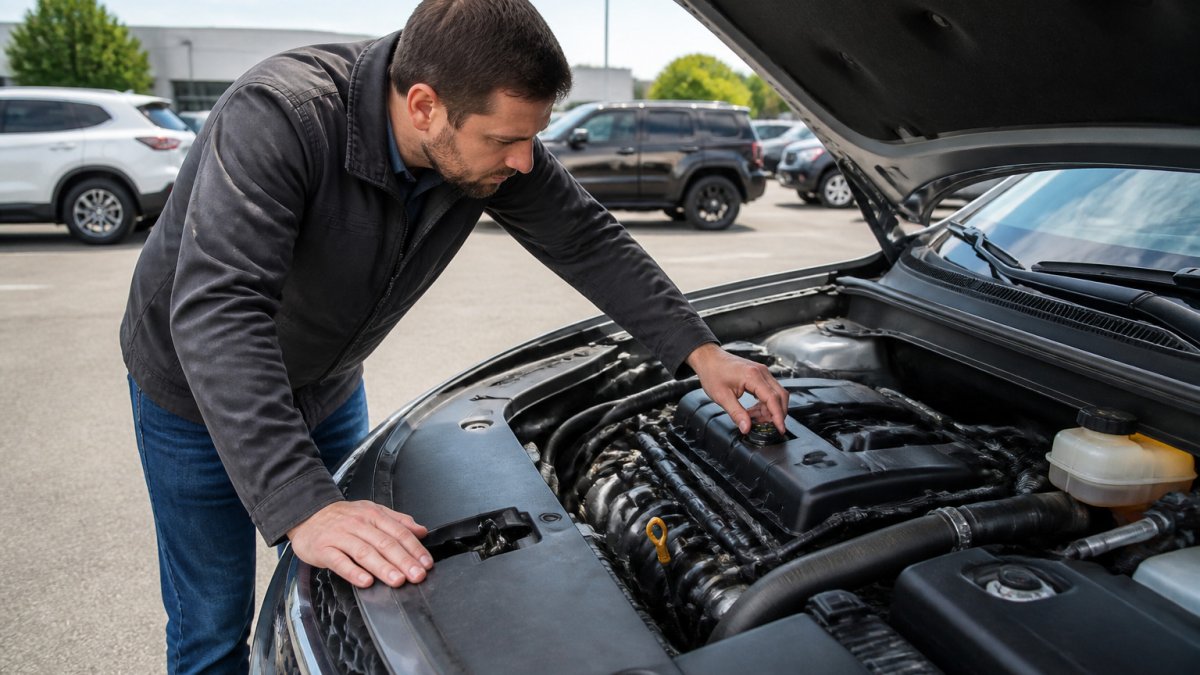 Buyer inspecting an engine bay to identify hidden mechanical issues in a used SUV at a dealership
Cold-engine checks (do these before the seller starts the car):
- Pull the oil dipstick. The level should sit between the marks, and the oil should look amber to dark brown, not milky, not gritty, and not black with a burnt smell.
- Check the coolant in the reservoir and, if the radiator cap is cool to the touch, at the radiator neck. Rusty, oily, or sludgy coolant points to a cooling system that has been neglected or contaminated.
- Look at the battery terminals for white or green corrosion, and check the battery date sticker. Check the battery date sticker to see how old the battery is.
- Squeeze the upper and lower radiator hoses. They should feel firm, not soft, bulging, or cracked. A hose that collapses when squeezed is close to failure.
- Inspect the serpentine belt for glazing, fraying, or missing ribs. A squealing belt on startup is a cheap fix; a snapped belt strands the car.
- Look for wet spots or residue around the valve cover, oil pan, and transmission pan. Fresh oil on a clean engine is a stronger warning than old grime on a dirty one.
- Check the brake fluid level and color. Dark, murky fluid suggests it has not been flushed on schedule.
Warm-engine checks (after the seller starts it):
- Watch the exhaust on startup. A puff of white vapor on a cold morning is normal.
- Listen for ticking, knocking, or squealing at idle. Rev the engine gently in neutral and listen for a change in pitch.
- Let the engine idle for two to three minutes and watch the temperature gauge. It should climb to the normal range and hold there. A gauge that keeps rising, or a cooling fan that never kicks on, is a red flag.
- Turn on the A/C and the heater and confirm both blow at the expected temperature. A weak heater can point to a failing heater core or a cooling system air pocket.
Checks that need a lift or a mechanic:
- Frame and underbody rust, especially on the rocker panels, subframe, and brake lines
- Suspension components, ball joints, tie rod ends, and control arm bushings
- Exhaust leaks and catalytic converter condition
- Transmission and differential fluid condition, which often requires a drain plug or a scan tool to read temperature
Watch out: a freshly detailed engine bay can hide oil residue and coolant stains. Ask the seller not to wash the engine before you look.
The checks below group the under-the-hood inspection by when to run them, so you can work through the car in the same order every time.
| Check | What to look for | Warning sign |
|---|---|---|
| Oil dipstick | Level between marks, amber to dark brown | Milky or gritty oil |
| Coolant reservoir | Clean coolant at the right level | Rusty, oily, or sludgy coolant |
| Radiator hoses | Firm when squeezed | Soft, bulging, or cracked hose |
| Serpentine belt | Intact ribs, no glazing or fraying | Squealing on startup, missing ribs |
| Engine bay residue | Clean, dry surfaces | Fresh oil around valve cover or pans |
| Brake fluid | Clear to light color | Dark, murky fluid |
| Temperature gauge | Climbs to normal and holds | Keeps rising, or fan never kicks on |
| Heater and A/C | Both blow at expected temperature | Weak heat |
Step 3: Look for Signs of Engine Damage
Engine problems are some of the costliest to fix, so take your time here. Check the oil cap and dipstick. Milky oil can point to a cooling system leak, while dark, gritty oil may mean neglect.
Listen for knocking, ticking, or squealing when the engine starts and idles. Also watch for blue or white smoke from the tailpipe. Smoke that lingers after startup is a common sign of worn parts.
Step 4: Follow a Used Car Test Drive Checklist
A short loop around the block will not reveal much. Plan a test drive of at least 15 to 20 minutes on mixed roads, including highway speeds.
Pay attention to:
- Brakes that pull to one side or pulse under the pedal
- Rough or delayed shifting in the transmission
- Steering that wanders, or vibration at higher speeds
- Clunking over bumps, which can signal worn suspension parts
Turn off the radio. You will hear more.
Step 5: Read Warning Lights and OBD-II Codes
Every car made since 1996 has an OBD-II port, usually under the dashboard near the steering column. A basic OBD-II scanner can pull trouble codes that the dashboard may not show. Reading the codes properly lets you tell a minor sensor fault from a more serious problem.
What the dashboard lights tell you:
- A solid check engine light means a fault needs attention, but the car is usually safe to drive to a shop.
- A flashing check engine light signals a misfire severe enough to damage the catalytic converter. Do not drive far on a flashing light.
- A red oil-pressure or temperature light means stop the engine now, not at the next exit.
- An ABS or traction-control light that stays on after startup points to a wheel-speed sensor or a hydraulic fault.
What the scanner tells you that the dashboard does not:
- Pending codes. These are faults the computer has seen once but not yet confirmed. A pending code is an early warning, often the same code will mature into a stored code within a few drive cycles.
- Permanent codes. These are stored until the computer verifies the repair over several drive cycles. They cannot be cleared with a scan tool, which makes them useful evidence that a fault was real.
- Freeze-frame data. Most scanners capture the engine speed, load, and temperature at the moment the code set. That snapshot tells you whether the fault happens at idle, under load, or when cold.
- Readiness monitors. These are the self-tests the computer runs on systems like the catalytic converter, oxygen sensors, and EVAP. If a seller cleared the codes right before you arrived, most monitors will read "not ready." A car that has been driven normally for a week will show most monitors as "ready." Monitors stuck at "not ready" after a long test drive are a sign the codes were recently wiped.
- Live data. Watch the coolant temperature reading after a cold start. It should climb steadily to roughly 195-220°F and hold. A reading that stays low points to a stuck-open thermostat; one that spikes points to a cooling problem. Watch the oxygen sensor voltages switch as the engine idles, a lazy sensor shows up here before it sets a code.
How to read the codes themselves:
- Codes that start with P0 are powertrain codes; P1 codes are manufacturer-specific. A P0420 (catalyst efficiency) is often a worn catalytic converter, but it can also be a downstream oxygen sensor or an exhaust leak, do not assume the worst or the cheapest fix.
- A P0300-series code means a misfire; the last digit tells you which cylinder. A single-cylinder misfire is often a coil or plug, while a random misfire across cylinders points to a vacuum leak or fuel delivery problem.
- Transmission codes (often P0700-series) deserve a mechanic's eyes even if the car drives fine, because internal wear does not always show up in a short test drive.
Watch out: a seller who says "the light just came on, it's probably the gas cap" may be right, a loose cap sets an EVAP code, but a cleared code history and unready monitors tell a different story.
Booking a Pre-Purchase Car Inspection With a Trusted Mechanic
Even a careful buyer should get a professional inspection. An independent mechanic can lift the car, check the frame for damage, and test the systems you cannot reach yourself.
Bring this guide and your notes to the appointment. Ask the mechanic to focus on any warning signs you found.
A pre-purchase inspection can help you negotiate a fair price, or give you the confidence to walk away.
Frequently Asked Questions
How do you know if you have engine damage?
Common signs include knocking or ticking sounds from the engine, blue, white, or black exhaust smoke, oil or coolant leaks under the vehicle, a check engine light that stays on or flashes, and noticeable loss of power during acceleration. Check the oil on the dipstick for a milky or gritty texture, which can indicate coolant or metal contamination. Any of these symptoms warrants a professional diagnosis before you buy, because engine repairs are among the most expensive a vehicle can need.
What should you check under the hood when buying a used car?
Start with fluid levels and condition: engine oil should be amber to dark brown and not milky, coolant should be clean and at the proper level, and brake and transmission fluid should look clear rather than burnt. Inspect belts for cracks or glazing, hoses for bulges or soft spots, and the battery terminals for corrosion. Look for fresh oil residue around gaskets and the valve cover, which can signal leaks. A used car inspection checklist keeps these steps consistent from one vehicle to the next.
How can you spot transmission problems during a test drive?
Pay attention to how the vehicle shifts from first gear into second and up through higher gears. Delayed engagement when you shift into drive or reverse, harsh or slipping shifts, flaring RPMs without a matching increase in speed, and whining or clunking sounds all point to possible transmission trouble. Accelerate gently and then more firmly on a highway on-ramp to check for consistent power delivery. Repeat the drive at least once so you can compare how the transmission behaves when warm and cold.
Why should you get a pre-purchase inspection before buying a used car?
A pre-purchase inspection by an independent mechanic gives you an objective assessment of the vehicle's mechanical and electrical condition, including items that are hard to see during a casual walkaround, such as worn suspension components, early-stage leaks, and diagnostic trouble codes stored in the computer. The inspection can reveal problems that justify a lower price or a decision to walk away. Ask the mechanic to put findings in writing so you can use them in your negotiation.
