Which Reliable Used Trucks Work Best for Local Contractors?

Last Updated: November 4, 2026
Quick Summary
The most reliable used trucks for local contractors are full-size pickups like the Ford F-150, Chevrolet Silverado 1500, RAM 1500, and GMC Sierra 1500 for general work, with heavier 2500 or 3500 models for frequent heavy towing. Match the truck to your trade's payload and towing needs, and check the maintenance history before buying any used trucks.
- Write down your typical payload, towing weight, and daily mileage before shopping.
- Under $20,000, expect higher mileage, so maintenance history matters more than price.
- Check the door-jamb sticker for the exact payload, since configuration changes ratings.
- Subtract tools, service bodies, and trailer tongue weight from payload before committing.
- Get a pre-purchase inspection from an independent mechanic before buying.
Table of Contents
- What Local Contractors Need From a Used Work Truck
- Most Reliable Used Trucks Under $20,000
- Best Used Trucks to Buy Under $15,000
- Light-Duty or Heavy-Duty: Matching the Truck to Your Trade
- Towing and Payload Capacity Explained With Real-World Limits
- Used Truck Inspection Checklist for Contractors
- Mileage, Maintenance Records and Total Cost of Ownership
- Choosing Your Next Work Truck at Premier AutoGroup
- Frequently Asked Questions
Choosing a reliable used truck for contracting work comes down to matching the truck to your trade, its real payload and towing limits, and its maintenance history. This guide walks through what to look for before you buy a used work truck.
What Local Contractors Need From a Used Work Truck
A work truck has to do more than get you to the job site. It needs to carry tools and materials, tow equipment, and start every morning without drama. Most contractors need a truck that handles daily hauling, survives rough roads and gravel lots, and keeps repair bills predictable.
Start with the work you do most often. A plumber hauling pipe and small tools has different needs than a contractor pulling a loaded equipment trailer. Write down your typical payload, towing weight, and daily mileage before you shop. Those numbers narrow the field faster than any list of models.
Watch out: a truck that looks solid on a test drive can still carry hidden wear from heavy use. Ask for service records and check them against the mileage.
Most Reliable Used Trucks Under $20,000
Under $20,000 you will mostly find well-used full-size pickups and some midsize trucks. Expect higher mileage, so the maintenance history matters more than the sticker price.
Full-size pickups such as the Ford F-150, Chevrolet Silverado 1500, RAM 1500, and GMC Sierra 1500 are common choices for general contracting. Their parts are widely available.
Best for: general contractors who need a balance of towing power and everyday utility. Skip if: you regularly tow heavy loads near the top of the rating. A heavier-duty truck will serve you better.
The Toyota Tacoma is a midsize option that fits tight job sites and city parking. Its tradeoff is a smaller cabin and bed, so it suits lighter hauling more than full-size work.
Best for: contractors who work in tight spaces or need off-road access to remote sites. Skip if: you haul full sheets of plywood or regularly tow a trailer.
Best Used Trucks to Buy Under $15,000
Choosing the cleanest, best-documented example you can find is generally a sound approach over simply picking the cheapest one.
Light-Duty or Heavy-Duty: Matching the Truck to Your Trade
Light-duty and heavy-duty trucks are built to different standards, and the right class depends on what your trade actually hauls day to day. Light-duty half-ton pickups (Ford F-150, Chevrolet Silverado 1500, RAM 1500, GMC Sierra 1500, Toyota Tundra) use lighter frames, smaller axles, and lower spring rates. Heavy-duty trucks (Ford F-250/F-350 Super Duty, Chevrolet Silverado 2500HD/3500HD, RAM 2500/3500, GMC Sierra 2500HD/3500HD) use thicker frames, larger brakes, heavier axles, and available diesel engines built for sustained load.
The practical difference shows up in three places: payload, towing stability, and how the truck holds up after years of loaded work. A half-ton can handle most tool-and-material hauling and occasional trailer duty, but its springs, brakes, and transmission cooler are sized for lighter duty. A heavy-duty truck is engineered for frequent near-max towing and high payload, which is why it costs more to buy, insure, and maintain.
Match the class to the trade rather than to the badge:
- Electricians and low-voltage contractors: A half-ton with an extended cab or crew cab and a locking bed or service body covers conduit, wire reels, and ladders. Payload needs are usually modest, so a light-duty truck keeps fuel and maintenance costs down.
- Plumbers: Pipe, fittings, and a small water heater or pump load favor a half-ton or three-quarter-ton with a service body. If you tow a loaded pipe trailer regularly, step up to a 2500-class truck for the heavier rear axle and brakes.
- Landscapers: Mowers, aerators, and mulch loads push payload quickly. A three-quarter-ton or one-ton chassis with a flatbed or landscape body is common because the added equipment weight eats into the truck's rated payload.
- General contractors: A half-ton crew cab handles crew transport and mixed material loads, but if you pull a skid-steer or equipment trailer several times a week, a 2500 or 3500 truck is the safer long-term choice.
- Roofers and framers: Material loads are heavy and concentrated. A one-ton dually or a chassis-cab with a flatbed distributes weight better and improves stability under load.
Watch out: the maximum towing or payload figure quoted for a truck applies to a specific configuration. A crew cab, four-wheel drive, and a diesel engine can cut payload by hundreds of pounds compared with a base regular-cab two-wheel-drive truck. Always check the door-jamb sticker on the exact vehicle. Because the exact configuration determines whether a truck can handle the load, make critical truck inspections part of verifying its ratings and condition before you buy.
If you only tow occasionally and your payload stays well under the half-ton's rating, a light-duty truck is usually the better financial choice. If your work regularly pushes near the limit, the heavier truck's larger brakes, cooling system, and frame will cost less over time than repairing a half-ton that was asked to do a heavy-duty job.
The table below summarises which truck class suits each trade, based on the hauling needs described above.
| Trade | Suggested class | Reason from the article |
|---|---|---|
| Electricians | Half-ton, extended or crew cab | Modest payload; conduit, wire reels, ladders |
| Plumbers | Half-ton or three-quarter-ton | Pipe, fittings, small water heater or pump |
| Landscapers | Three-quarter-ton or one-ton | Mowers, aerators, mulch loads push payload |
| General contractors | Half-ton crew cab; 2500/3500 if towing often | Frequent equipment trailer use needs heavier class |
| Roofers and framers | One-ton dually or chassis-cab | Heavy, concentrated material loads |
Towing and Payload Capacity Explained With Real-World Limits
Towing capacity is the maximum weight a truck is rated to pull, including the trailer and everything on it. Payload capacity is the maximum weight the truck itself can carry, passengers, tools, cargo, and the tongue weight the trailer presses down on the hitch. Most contractors focus on towing and ignore payload, but payload is the number that gets exceeded first on a loaded work truck.
The catch is that both ratings are configuration-specific. The same model year and model name can carry very different ratings depending on cab style, bed length, drivetrain, engine, axle ratio, suspension package, and trim. A regular-cab two-wheel-drive work truck may be rated to carry far more than a crew-cab four-wheel-drive truck with the same engine, because the extra cab, four-wheel-drive hardware, and options add weight before you load a single tool.
To find the real limit for a specific truck:
- Open the driver's door and find the tire and loading information label, which lists the vehicle's payload capacity as built.
- Check the hitch receiver label and the owner's manual for the truck's rated tow capacity for that exact configuration.
- Subtract the weight of your crew, tools, and any added equipment from the payload figure.
- Subtract the trailer's tongue weight (typically 10 to 15 percent of a conventional trailer's loaded weight) from the remaining payload.
- Compare the result with what you actually plan to haul. If the margin is thin, move up a class.
Work-ready upfits change the math. A steel service body, ladder rack, winch bumper, or bed liner adds weight before any cargo goes in, and that weight comes directly out of payload. A truck with a 1,500-pound payload rating and a 600-pound service body has about 900 pounds left for tools, materials, and tongue weight. This is why landscapers and plumbers often choose a heavier chassis when they plan to add a body or rack.
Watch out: a trailer's loaded weight is easy to underestimate. A utility trailer rated for 7,000 pounds can weigh close to that once loaded with equipment, and tongue weight plus cargo can push a half-ton past its payload rating even when the trailer is within the tow rating. Weigh the loaded trailer at a public scale before you commit to a truck.
Used Truck Inspection Checklist for Contractors
Before you buy, inspect the truck the way a mechanic would. Use this checklist:
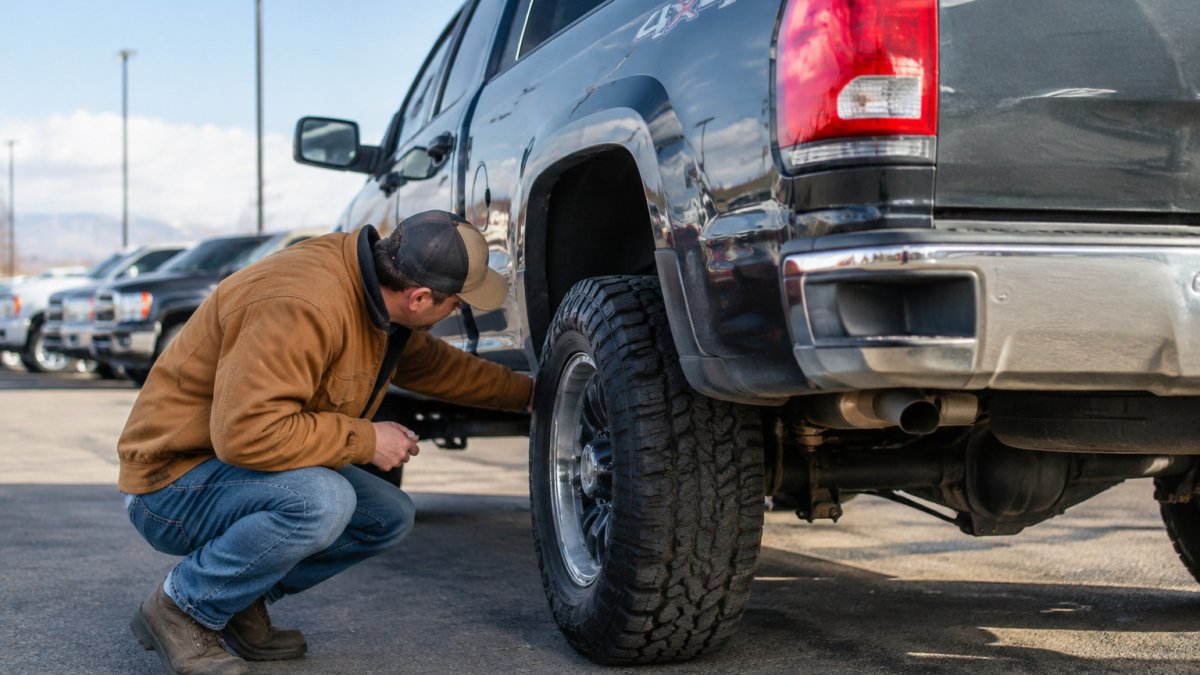 Contractor inspecting the bed and undercarriage of used trucks at a dealership lot during the day
- Check the frame and underbody for rust, cracks, or previous repairs
- Look for oil leaks around the engine and differential
- Test the transmission through all gears, including reverse
- Inspect the bed for dents, cracks, and damaged tie-down points
- Confirm the trailer brake controller and hitch wiring work
- Review service records for regular oil changes and timing belt work
- Get a pre-purchase inspection from an independent mechanic
Mileage, Maintenance Records and Total Cost of Ownership
A higher-mileage truck with complete service records can outlast a lower-mileage truck with no history. Ask for records showing regular oil changes, cooling system work, and drivetrain maintenance.
Total cost of ownership includes the purchase price, fuel, insurance, repairs, and downtime. For a working contractor, downtime often costs more than the repair itself. A truck with a strong parts supply and a proven track record can keep you working, which is why reliability matters as much as price.
Choosing Your Next Work Truck at Premier AutoGroup
At Premier AutoGroup, we offer a wide selection of quality used cars, SUVs, trucks, and vans. Our advisor-style team gives you honest, no-pressure guidance, and we can talk through financing options if your credit history is a concern. You can browse our current used truck inventory to see which models are available now and compare them against the criteria in this guide.
Frequently Asked Questions
What's the most dependable used truck to buy?
Reliability depends heavily on the specific engine, maintenance history and mileage, so a verified service record matters more than the model name alone. Ask for records, get a pre-purchase inspection and compare the truck against the used truck inspection checklist in this guide before you commit.
What used trucks should you stay away from?
Be cautious with trucks that have unclear service histories, signs of frame damage, or prior fleet or heavy commercial use with no documentation. Diesel models in particular can carry higher maintenance costs, so factor those into your budget. Variable reliability can also show up depending on engine choice within the same model year, which is why checking the exact configuration matters.
How many miles is too many for a used work truck?
Mileage alone does not decide it. A well-maintained truck with 150,000 miles and complete records can outlast a neglected one with fewer miles. Look at how the miles were driven, whether the timing belt or major services were done on schedule, and how the truck runs on a test drive. Higher-mileage trucks often make sense for contractors on a tight budget if the condition checks out.
Should a contractor buy a used half-ton or heavy-duty truck?
A half-ton such as a Ford F-150 or Chevrolet Silverado 1500 suits contractors who tow light trailers and haul moderate loads daily. Heavy-duty models like the Ford F-250 or Chevrolet Silverado 2500HD make sense when you regularly tow heavy equipment or carry large material loads. Heavy-duty trucks cost more to maintain and are harder to park, so match the truck to the work you actually do.
